 by
by So if you have genuine interest or really want to get into cyber. I will do my best to break this down into a multi-part series of posts so you can be better prepared.
Let’s start with understanding that Cybersecurity is really an umbrella term or division or section. Every one in a Cybersecurity umbrella is usually assigned a specialty or job that is specific to their “advanced skillsets”.
To make this the easiest way to process or understand the cybersecurity umbrella, it’s best to seperate things in very simple terms.
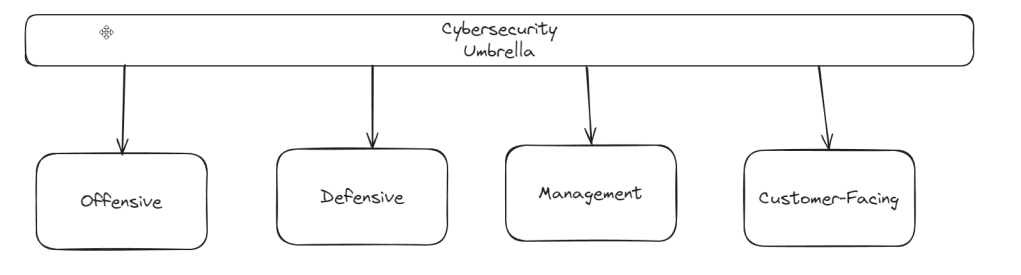
Category A: Offensive
Category B: Defensive
Category C: Management
Category D: Customer-Facing
Now each Category has different specialties or skills inside of them that can be attributed to a special field. To not overwhelm you the reader I will do a brief breakdown of each one.

Category A: Offensive – This category is someone who wants to specialize being on the attack, someone who can stress a network, user or physical environment. Someone who wants to see if they can find a hole or a breach point which could eventually lead up to a catastrophic event. But the intention is to seal the breach and find any loop holes to protect the network.
– Physical/Web/Network Penetration Tester
– Vulnerability Assessment
– Offensive Security Engineer

Category B: Defensive – This category is someone who wants to be the shield, the armor the guard on duty ready to defend anything and everything. This can also be someone who is finding the threats and shutting them down or finding the answers.
– SOC Analyst
– Reverse Malware Engineer
– DFIR (Digital Forensics Incident Response) Expert

Category C: Management – This category is someone who is more of a leader or the face of the division. Someone who is taking charge in majority of the changes within the time and what must be done for the team.
– CISO (Chief Information Security Officer)
– Sr (Any Role) Officer
– Management of (Division)

Category D: Customer-Facing – This category I like to call the client to personnel. You usually will always interact with clients or people to address security issues, concerns, advancements or improvements. But the intention is for the customers best interest.
– Cyber Sales Member
– Cyber Audit Specialist
– Cyber Technical Support
Each of these categories are in simple form or just how I would categorize them. Understand one cybersecurity professional can have a finger in multiple spots or a position like a Cybersecurity Engineer can be someone who specializes in DFIR and Vulnerability Assessment and also does auditing. In the end depending on where you work or what the org demands are of a position is entirely up to them.
Now we will discuss the step by step process to getting into cyber and what I deem is important as well as the tools / reason / purpose to that path.
 CyberSecurity Blog